Olahraga: Movement for Real Life

Bodyweight routines designed for the actual conditions of a busy professional's day. Fifteen minutes. No gym. No equipment beyond the floor beneath your feet.

The Context

Why Fifteen Minutes Is a Real Number

The standard advice about exercise volume is well-established in the public health literature. Most Indonesian adults are aware, in general terms, that regular physical activity is associated with a range of positive health outcomes. The gap between that awareness and actual practice is not, in most cases, a knowledge problem. It is a time and access problem.

Fifteen minutes is not a compromise. It is a realistic unit of time that appears reliably in the schedule of most working professionals. Between meetings. Before a call starts. During a lunch break that will not be used for lunch anyway. The question is not whether fifteen minutes is enough to achieve some idealised fitness outcome. The question is whether fifteen minutes of deliberate movement is better than no movement. The answer to that question is not complicated.

The routines described in this section are drawn from publicly available exercise science and adapted for the constraints of an office environment. They do not require equipment. They do not require changing clothes, in most cases. They require only the willingness to move during a brief window of available time.

A note on the relationship between Jamu culture and movement: traditional Indonesian daily life involved considerably more incidental physical activity than contemporary urban professional life does. The Jamu vendor who walks several kilometres through a market before seven in the morning is not thinking about her step count. She is doing her work. The integration of movement into daily activity, rather than its separation into a dedicated exercise session, is something the modern approach to fitness is slowly rediscovering. We find that worth noting.
The Routines

Four Fifteen-Minute Formats

Each of the following describes a format for a fifteen-minute bodyweight session. They are informational descriptions of movement patterns, not personalised training prescriptions. Consult a qualified fitness professional or healthcare provider before beginning any new movement practice.

The Morning Mobilisation

15 minutes

A sequence focused on joint mobility rather than muscular effort. Suitable for the period immediately after waking, before the body has warmed to its full range of motion.

  • Cervical circles, slow and controlled, both directions
  • Shoulder rolls and cross-body arm swings
  • Thoracic rotation from a seated position
  • Hip circles standing, both directions
  • Ankle rolls and calf raises
  • Cat-cow spinal movement on the floor
  • Child's pose to cobra, repeated slowly

The emphasis here is movement quality, not intensity. Each movement performed with attention is more useful than many movements performed quickly.

The Between-Meetings Reset

15 minutes

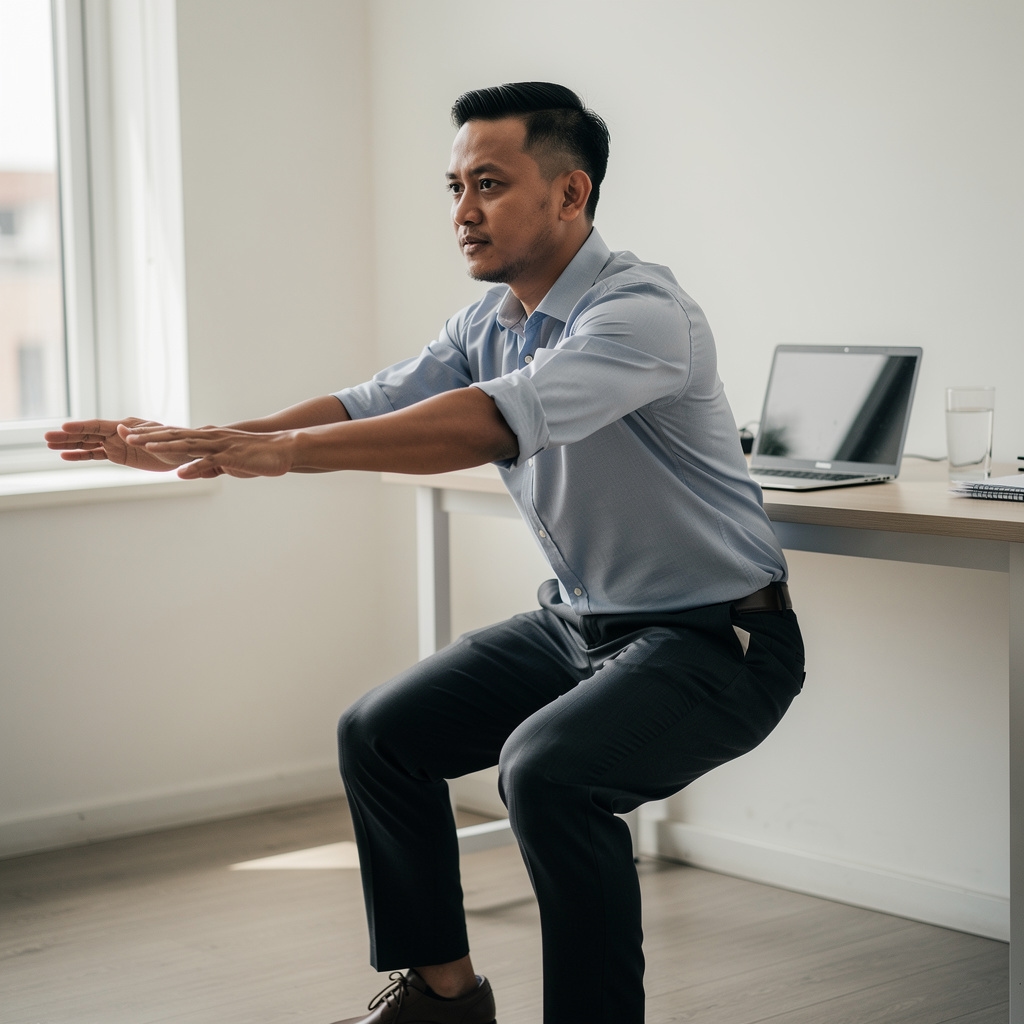
Designed for the gap between scheduled calls or meetings. Can be done in office clothes without generating significant perspiration. Focuses on the postural patterns that prolonged sitting disrupts.

  • Wall angels: standing against a wall, arms tracing overhead
  • Seated or standing hip flexor stretch, held for thirty seconds each side
  • Bodyweight squats, slow and controlled, focusing on depth
  • Incline push-ups against a desk or wall
  • Standing balance on one leg, alternating
  • Neck stretches targeting the levator scapulae

The muscles most affected by extended sitting are the hip flexors, thoracic extensors, and deep neck flexors. This routine addresses all of them.

The Strength Foundation

15 minutes

A more demanding format for days when slightly more intensity is appropriate. Requires a clear floor space of approximately two metres by one metre. Not suitable for office environments without a private space.

  • Push-up variations: standard, wide, narrow
  • Bodyweight squat to single-leg squat progression
  • Reverse lunges, alternating legs
  • Plank hold, progressing to shoulder taps
  • Glute bridges, single-leg variation when ready
  • Superman hold for posterior chain engagement

Consistency over intensity. A fifteen-minute session done daily builds more than a one-hour session done occasionally.

The Evening Wind-Down

15 minutes

A low-intensity sequence designed for the period before sleep. The goal is parasympathetic activation rather than physical exertion. Works well in combination with the breathing practices described in the Kesehatan Mental section.

  • Legs-up-the-wall pose, held for five minutes
  • Supine spinal twist, both sides
  • Seated forward fold with relaxed spine
  • Pigeon pose or figure-four stretch for hip external rotators

The relationship between end-of-day movement and sleep quality is documented in the public health literature. This sequence is not a sleep intervention. It is a way of transitioning from the demands of the day to a quieter physical state.

Cultural Context

Movement as Part of a Daily Practice

The Jamu tradition did not exist in isolation from physical activity. The women who prepared and sold Jamu were, almost by definition, physically active. The preparation itself is demanding work. The distribution, in the case of Jamu gendong vendors, involves carrying significant weight over considerable distances through early morning markets.

There is something worth reflecting on in the contrast between that mode of daily life and the sedentary professional existence that now characterises urban Indonesian working culture. The traditional Indonesian day involved movement that was integrated with work and domestic life rather than separated from it as a dedicated activity.

The modern approach to fitness as a scheduled, discrete activity is a response to the conditions of contemporary work. It is a reasonable response. But it is worth understanding that the separation of movement from daily life is itself a relatively recent development, and that the traditional model of integrated physical activity has something to teach about sustainability and consistency.

This is not an argument against structured exercise. It is an argument for looking at movement more broadly. Walking to a meeting rather than calling in. Taking stairs. Standing during calls. These are not fitness strategies in the conventional sense. They are a partial return to the kind of incidental movement that characterised daily life before the desk became the primary work environment.

Indonesian professional doing bodyweight exercise in office space

About the Information on This Page

The movement descriptions on this page are informational. They are based on publicly available exercise science literature and general principles of bodyweight movement. They are not personalised training prescriptions and do not account for individual health conditions, injuries, or physical limitations. Before beginning any new movement practice, particularly if you have existing health conditions or have been inactive for an extended period, consult a qualified healthcare professional or certified fitness professional.